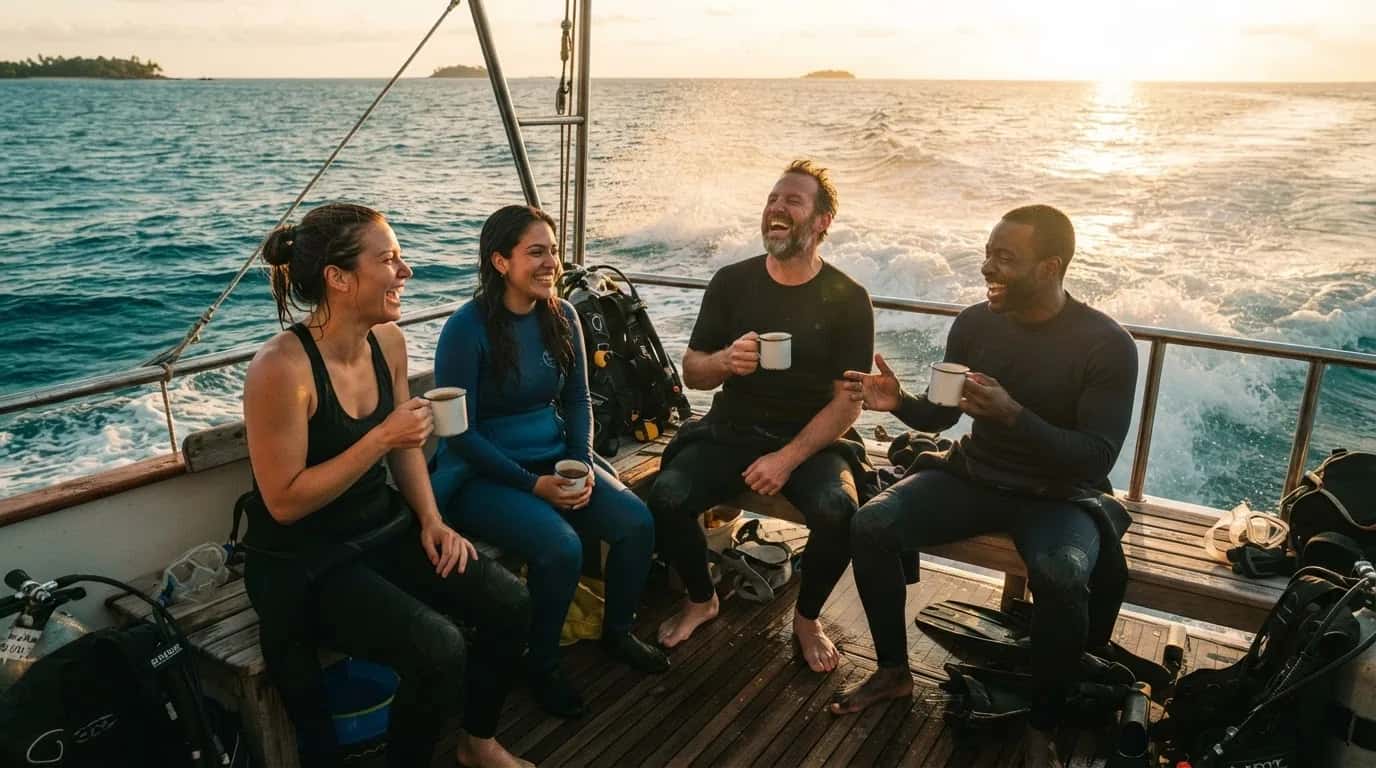
There is a moment that every diver knows. It happens somewhere between the surface and the thermocline, when the noise of the world fades and your breath becomes the only rhythm that matters. In that silence, something shifts. You are no longer just a person with a tank on your back. You are part of something ancient, something wordless, something shared.
That feeling — the one that keeps us coming back to the water, that makes us rearrange our lives around dive trips, that transforms strangers into family over a single surface interval — is not an accident. It is the tribe effect. And it is among the most powerful forces in adventure-travel community building and dive community loyalty.
Some brands spend millions trying to manufacture loyalty. They build points programs, send discount codes, optimize retargeting pixels. But niche adventure communities? They do something far simpler and far more profound: they make people feel like they belong to something that matters.
We have spent the last year studying three of the most unbreakable communities in the adventure world: the digital tribe that predates social media, the regional network that turned a desert gathering into a global movement, and the conservation force that mobilized 70 million people to protect what they love. What we found changed how we think about building a community for DeepBeat Dive Festival.
This is what they do. This is why it works. And this is how we are building something the ocean has never seen.
How do adventure communities build loyalty? The strongest ones (DeeperBlue, Burning Man's regional network, PADI AWARE) do five things: they solve loneliness, make each member's contribution visible, write their values down, hold regular rituals of reunion, and offer a ladder of identity from newcomer to leader. Loyalty follows belonging, not points or discounts.
The Digital Elders: How DeeperBlue Built a Tribe Before "Community" Was a Buzzword

In 1996, a twelve-year-old Stephan Whelan took his first breath underwater in a hotel pool on holiday. That single moment would eventually become DeeperBlue.com — the world's largest online community dedicated to freediving, scuba diving, ocean advocacy, and diving travel.
But here is what makes DeeperBlue remarkable: they built this dive community before Facebook existed. Before "engagement metrics" were invented. Before anyone knew that niche content could scale. They did it the hard way — one article at a time, one forum thread at a time, one diver who felt seen.
Today, by DeeperBlue's own published figures (as of 2026), the site reaches more than a million visitors a month, with over a million social followers, tens of thousands of forum threads and a newsletter that readers voluntarily opted into in an age of infinite content noise.
Yet the real magic is not in the reach. It is in the return.
DeeperBlue's audience, by its own account, skews highly educated and affluent. They are not passive scrollers. They are decision-makers who plan dive trips, buy equipment, and — most importantly — bring others into the sport. When a community attracts this level of educated, affluent engagement, it is not because of algorithms. It is because the community delivers something the algorithm cannot: genuine competence, shared identity, and the feeling that someone, somewhere, understands why you would travel 4,000 miles to sleep on a boat with strangers.
Why are DeeperBlue members so loyal?
The Buddy Finder. DeeperBlue's International Buddy Network is not a feature. It is a lifeline. Divers post in region-specific threads — "Find a Buddy or Training Partner in Asia & Japan" — and actual human connections form. In a sport where your literal survival depends on the person next to you, finding your people is not optional. It is existential.
The Gatekeeping of Quality. DeeperBlue does not chase virality. They have published thousands of articles under editorial standards that have earned industry awards. In a world of AI-generated listicles, their content requires expertise. That expertise creates trust. And trust creates the kind of loyalty that survives platform shifts, algorithm changes, and the death of every social network that once promised to "connect the world."
The Ritual of the Podcast. The DeeperBlue Podcast is not the largest in diving. But it is consistent. It is intimate. It is the voice of the tribe in your headphones during your commute, your workout, your surface interval. Ritual — the predictable rhythm of showing up — is what transforms audiences into communities.
Burning Man's Regional Network: one week, year-round identity

In 1986, a small group of friends gathered on Baker Beach in San Francisco to burn an eight-foot wooden man. They could not have known they were igniting a cultural movement that would reshape how we think about community, participation, and belonging.
By 1990, the gathering had moved to the Black Rock Desert. By 1996, 8,000 people were making the pilgrimage. But something unexpected happened after the flames died down and the last RV rolled back to civilization. People felt something that mainstream society had failed to deliver: the sense of being connected to something larger than themselves.
Zac Bolan, an early Regional Contact from Calgary, described it perfectly in the Regional Network's own history: "After returning from the playa in 1997, I felt an intense loneliness caused by my alienation from the people in my community. Acting as a Regional Contact kept me sane during these early days. I was able to form my own support network until a regional community came into being."
That loneliness — the ache of returning to a world that does not understand what you experienced — is the single most powerful retention mechanism in adventure communities. And Burning Man solved it by building something unprecedented: the Burning Man Regional Network that lets Burners live their identity 365 days a year.
The scale tells the story. According to the Burning Man Regional Network, official Regional Events now run across dozens of countries, from large gatherings like AfrikaBurn to intimate ones of fewer than 25 people, and Burners Without Borders runs chapters on six continents. The community does not wait for August. It builds, gathers, and creates year-round.
What Makes Burning Man's Regional Network Sticky
The 10 Principles as Behavioral Code. Burning Man's culture is not enforced by moderators. It is encoded in 10 Principles — Radical Inclusion, Gifting, Decommodification, Radical Self-Reliance, Radical Self-Expression, Communal Effort, Civic Responsibility, Leaving No Trace, Participation, and Immediacy. These are not suggestions. They are the DNA of belonging. When a community has explicit values, members can self-select. The people who stay are the people who belong.
The Ritual of Reunion. Decompression events. Regional burns. Art parties. Community workshops. The Burning Man calendar never truly ends because the community refuses to let it. As one researcher noted: "Group ritual activity creates the mechanisms for identifying group members, ensuring commitment to the group, facilitating cooperation with coalitions, and maintaining group cohesion." The ritual is not the event. The ritual is the glue.
The Identity Transformation. A Ranger's reflection captures this perfectly: "The reason I keep coming back, the piece of the event that speaks to my soul, is the community, on its many levels, in its many faces. The sense of being connected, of caring about something larger than myself." Burning Man does not sell tickets. It sells a version of yourself that you cannot access anywhere else. And once you have met that version, you will do almost anything to return.
The Ocean Torchbearers: How PADI AWARE Turned Conservation Into a Membership Imperative

For over 30 years, PADI AWARE Foundation has been driving local action for global ocean conservation. But calling it a "conservation organization" misses the point. PADI AWARE is a loyalty engine disguised as a movement.
Consider the scale: PADI AWARE reports tens of millions of Ocean Torchbearers and PADI has issued tens of millions of certifications. Conservation programs that span marine debris removal, shark and ray protection, coral restoration, and citizen science. PADI has been recognised on Fast Company's Most Innovative Companies list, and press coverage has described PADI AWARE as one of the most powerful NGOs in the world.
But power is not the same as stickiness. What makes PADI AWARE truly remarkable is how they have embedded conservation into the identity of being a diver.
It starts with the Dive Against Debris program. Every piece of debris logged, every survey submitted, every data point collected — it all feeds into real scientific research that informs policymakers globally. Divers are not just cleaning the ocean. They are becoming scientists. They are becoming contributors to something measurable, something cited, something real.
Then there is Adopt the Blue — the world's largest network of underwater sites for conservation action. When a dive center "adopts" a site, they are not just marking coordinates on a map. They are claiming stewardship. They are saying: This patch of ocean is ours to protect. That sense of ownership is addictive.
And finally, the Conservation Action Portal (CAP) — a platform where divers track their contributions in real-time, compete with other centers, and watch their collective impact grow. As one dive operator noted: "CAP gives you the tools to market your conservation leadership effectively. You can use campaign updates and share real-time data to create compelling marketing content, showcase your actions, and help you stand out competitively."
What Makes PADI AWARE Sticky
The Feedback Loop of Impact. Most conservation asks people to give money and trust that something good happens. PADI AWARE gives divers the tools to see their impact — debris counts, species sightings, reef health data. When you can measure your contribution, you are far more likely to contribute again.
The Social Proof of Belonging. PADI AWARE Specialty courses, Eco Center designations, Torchbearer status — these are not certifications. They are identity badges. They signal to other divers: I am the kind of person who protects what I love. In a community where most new divers recommend their training agency to friends and family, that identity becomes self-reinforcing.
The Integration of Purpose and Play. PADI AWARE does not ask divers to stop diving and start protesting. It embeds conservation into the dive itself. Every descent becomes an act of science. Every ascent becomes a contribution. When purpose and pleasure merge, loyalty becomes effortless.
What do loyal adventure communities have in common?

Strip away the surface differences — a website, a desert, a nonprofit — and these communities share a structural DNA that explains their unbreakable loyalty and powers successful niche community growth:
1. They Solve the Loneliness Problem
Adventure communities do not compete with other activities. They compete with isolation. The dive buddy who becomes family. The Regional Contact who keeps you sane after the playa. The fellow Torchbearer who logs debris beside you on a reef survey. Every sticky community we studied solves the same fundamental need: the need to be known by people who share your passion.
2. They Make Participation Visible
DeeperBlue's forum post counts. Burning Man's volunteer Ranger hours. PADI AWARE's Conservation Action Portal dashboards. In each case, members can see their contribution. And visibility drives repetition. When you know your presence matters, you show up more often.
3. They Encode Values Explicitly
DeeperBlue's editorial standards. Burning Man's 10 Principles. PADI AWARE's Blueprint for Ocean Action. These are not marketing slogans. They are behavioral contracts. When values are explicit, members can self-police, self-select, and self-sacrifice for the collective. Communities with vague values attract vague members. Communities with sharp values attract sharp devotion.
4. They Create Rituals of Reunion
The weekly podcast. The regional burn. The annual Women's Dive Day across 100+ countries. Rituals create predictable moments of belonging in an unpredictable world. And predictability is the foundation of trust.
5. They Offer Identity Transformation
The person who discovers DeeperBlue is not the same person who becomes a forum moderator. The first-time Burner is not the same as the five-year Ranger. The Open Water student is not the same as the Eco Center operator. Sticky communities offer a ladder of becoming. And human beings will climb almost any ladder if the view from the top promises a better version of themselves.
How is DeepBeat building a dive community?

We have studied the masters. We have decoded their architecture. And now we are building something that has never existed at the intersection of ocean, sound, and soul.
DeepBeat is more than a festival. It is not a conference, and it is not a dive trip with a DJ. It is a tribe that gathers at the exact place where three extraordinary communities overlap: the divers who have been searching for their people, the music lovers who have been searching for their frequency, and the conscious travelers who refuse to separate adventure from impact. Check out meet the DeepBeat tribe to see how our global community is coming together, or discover how scuba diving alters your state of presence.
Here is how we are doing it differently.
The Three-Fold Invitation
Most communities ask you to join. We ask you to arrive.
DeeperBlue built a digital tribe. Burning Man built a physical network. PADI AWARE built a conservation army. We want to build all three, around three 2027 editions (Maafushi, Bali and Phuket) that serve as the gravitational centres for year-round connection.
The Digital Layer: The DeepBeat Dispatch is where the tribe starts: reef stories, ocean soundscapes and dive sites worth the trip.
The Physical Layer: The editions are the peak moments, and we hope to add meetups between them. We are not building an event. We are building a rhythm.
The Impact Layer: Coral planting sits at the heart of every DeepBeat gathering. It is part of how we think about belonging, and guests can take part through coral frame planting and adoption add-ons. Our coral restoration story explains the method.
The Music Dimension
Here is what none of the communities we studied have: a shared sensory language that transcends words.
As we explored in why sound travels faster underwater, sound traveling through water becomes a 360-degree experience that no land concert can replicate. When you hear music at 20 meters, you do not just hear it. You feel it in your bones, your chest, your breath. That sensation — the moment when the beat syncs with your bubbles and the reef becomes your dance floor — creates a bond that no forum thread, no regional burn, no conservation badge can match.
We are not adding music to diving. We are adding frequency to belonging.
The Intentional Limit
DeeperBlue scaled to millions. Burning Man grew to 110,000 regional participants. PADI reached 70 million Torchbearers.
We are capping the Maafushi launch edition (10–14 March 2027) at a few hundred guests.
Not because we cannot scale. Because we refuse to scale before the culture is sacred. Every founding member will know every other founding member by name. Every ritual will be tested, refined, and protected. And only when the tribe is unbreakable will we consider opening the invitation wider.
Some communities sell tickets. Others sell belonging. We are building the second.
The Invitation
The tribe is forming.
If you have ever felt the loneliness of returning from a transformative trip to a world that does not understand what you experienced, you are one of us.
If you have ever rearranged your calendar around a dive trip, a music festival, or a moment of beauty that you could not explain to your coworkers (some people travel 4,000 miles to sleep on a boat), you are one of us.
If you believe that protecting the ocean and celebrating it are not opposite impulses but the same impulse viewed from different depths, you are one of us.
Join the waitlist and claim your invitation. Waitlist members get first access to invitations. The invitation is limited. The ocean is waiting.
About DeepBeat — DeepBeat Dive Festival is a boutique dive and music festival. The launch edition is in Maafushi, Maldives, 10–14 March 2027. Join the waitlist.
Sources
- DeeperBlue: published audience figures (as of 2026)
- Burning Man Regional Network: regional events, history and contact quotes
- PADI AWARE Foundation: Dive Against Debris, Adopt the Blue and Torchbearer programmes
Frequently asked questions
- What is the tribe effect?
- The loyalty that forms when a niche community gives members belonging, visible contribution and shared rituals. Members stay for the people, not the product.
- What is Burning Man's Regional Network?
- A global network of officially recognised local events and contacts that let Burners gather year-round outside the main event.
- What is PADI AWARE's Adopt the Blue?
- A programme where dive centres adopt a dive site and run ongoing debris and reef surveys there.
- How can divers find a dive community?
- Through buddy forums, dive-centre clubs, conservation dives and dive festivals such as DeepBeat.