Conservation
Conservation at DeepBeat: a sustainable dive festival
Protect what we celebrate.
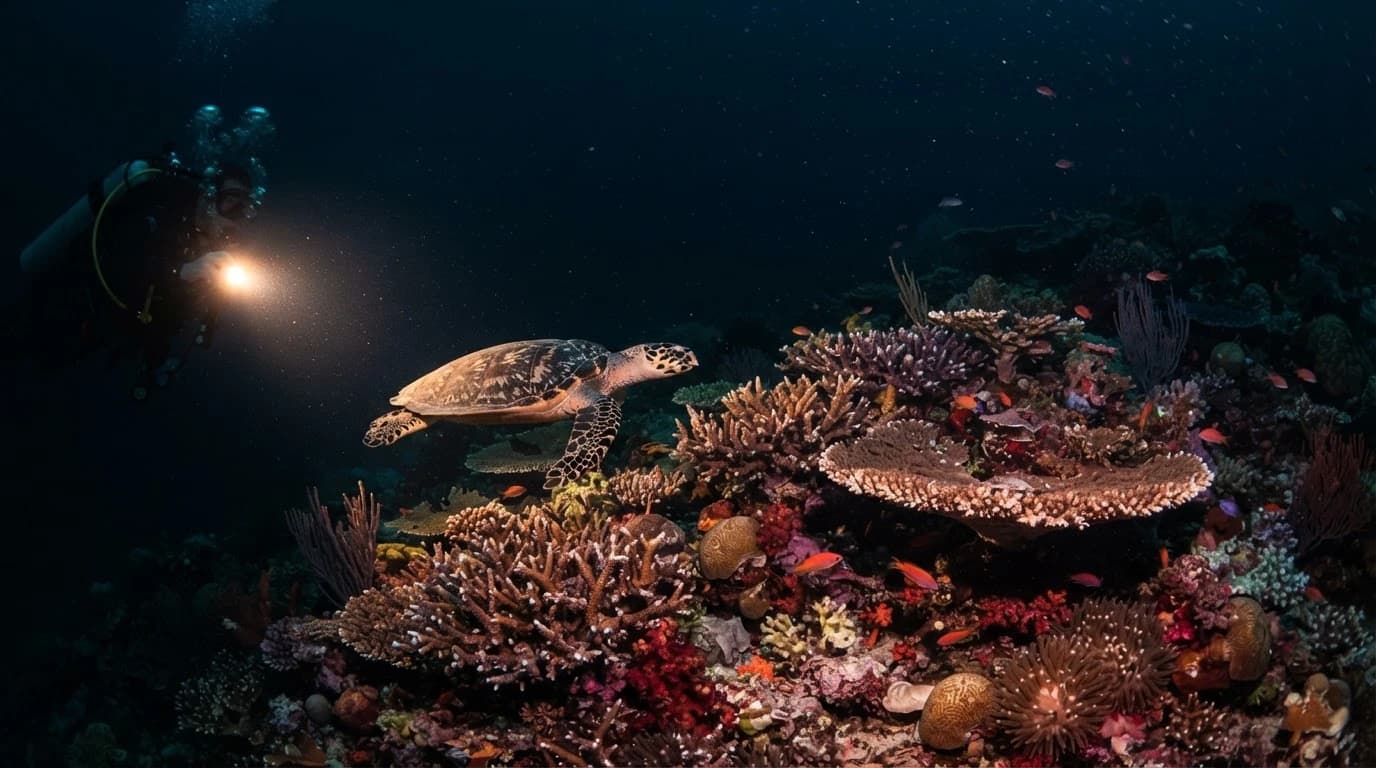
How does DeepBeat protect the ocean? Every edition includes four fixed commitments: reef-safe diving protocols, scheduled clean-up and ghost-net dives, marine education with local operators, and a public impact report. At the Maafushi launch (10–14 March 2027), guests also join coral planting. Results are published after each edition.
A festival that lives in the ocean answers to the ocean. Conservation isn’t a slide in our deck — it’s a pillar of the experience, built into every edition alongside the dives and the music.
Why A Music Festival Cares
A healthy reef is loud.
Snapping shrimp, grazing parrotfish, whale song carrying for miles — a living reef has a soundtrack. A dying reef goes quiet. Researchers have shown that playing recordings of healthy reef sound can help fish return to degraded coral (Gordon et al., 2019, Nature Communications). For a festival named after the beat beneath the surface, that silence is the one sound we refuse to leave behind. Read Can You Hear a Reef Dying?
So the music and the mission share a stage: conservation storytelling in the program, ocean soundscapes in the sets, and the reef itself as the reason the whole world exists.
Silence below, sound above — and a promise that the water stays alive enough to keep its own rhythm.
The Conservation Pillar
How does DeepBeat protect the reef? Four commitments, every edition.
Dive, Discover, Dance — and Conserve. The fourth pillar carries the other three.
Reef-Safe Protocols
The reef sets the terms; we dive as guests. Every diver follows the DeepBeat diver code below.
Clean-Up Dives
Every edition schedules working dives — ghost net recovery, debris sweeps, shoreline drives — so the water we celebrate in is left cleaner than we found it.
Marine Education
Reef walks, species briefings, and conservation storytelling woven into the program, built with local dive operators and marine communities who know these waters best.
Impact Reporting
What was recovered, what was restored, what was funded — published after every edition. Purpose you can audit, not a slide in a deck.
The DeepBeat diver code
- Buoyancy briefing before every descent
- No touching and no taking
- Reef-safe (non-oxybenzone) sunscreen only
- Moorings, never anchors
Marine education is built with local operators; learn the basics in How to read a reef like a marine biologist.
Coral planting and restoration
Coral planting is the heart of every DeepBeat gathering. At the Maafushi launch, certified divers and guests take part in guided restoration dives, attaching coral fragments to frames led by the local dive team. The planting method, partner and fragment target are confirmed with the host operator and published before the edition. See how restoration works in the Maldives: The Maldives coral restoration revolution.
What the impact report measures
Published on deepbeatdives.com after each edition, starting after the Maafushi launch in March 2027:
- Kilograms of debris removed
- Ghost nets recovered
- Coral fragments planted
- Funds contributed to local partners
Partners on the water
The Maafushi launch is hosted at Triton Exotica Resort. Conservation and dive-operator partners are announced as they are confirmed — we name partners only once they have signed on. Interested in joining? See Partners & Sponsors.
Inside An Edition
Purpose in the program, not the fine print.
Before the descent
Every diver passes a reef-safe briefing: buoyancy, distance, and how to move through a living ecosystem without leaving a trace.
During the edition
Clean-up dives sit on the main schedule beside the music — a working dive is a headline act, not a side event.
After the tide
Impact is counted, written up, and shared with the tribe and the local partners who hosted us.
All of it built with local marine communities and dive operators — every destination passes a bar that includes manageable permits, real dive infrastructure, and a culture worth protecting, not just a beach worth posting. More stories in Read the science: Ocean Conservation for Divers →.
DeepBeat conservation: common questions
- Is DeepBeat an eco-friendly festival?
- Every edition runs reef-safe protocols, scheduled clean-up dives, marine education and coral planting, and publishes an impact report afterwards.
- Do I have to join the clean-up dives?
- Clean-up dives are on the main schedule and open to every certified diver; non-divers can join shoreline drives.
- What sunscreen is allowed?
- Reef-safe mineral sunscreen only, free of oxybenzone and octinoxate.
- Where is the impact report published?
- On deepbeatdives.com after each edition, starting after the Maafushi launch in March 2027.
Dive With Purpose
The ocean gives the festival its stage. We return the favour.
Join the tribe and be part of the first edition’s impact — in the water, on the sand, and in the report that follows.
Join the Tribe